
Cherokee History and Outdoor Beauty
When someone mentioned Cherokee, N.C. to me in the past, I used to think of the big casino. Cherokee
turns out to have much more to offer than just gambling. The town combines kid-friendly Native
American education with natural beauty.
Located at the entrance of Great Smoky Mountain National Park, Cherokee borders Jackson County, N.C.
and the Eastern Band of the Cherokee Nation. When visiting the tourism website, I was surprised to see
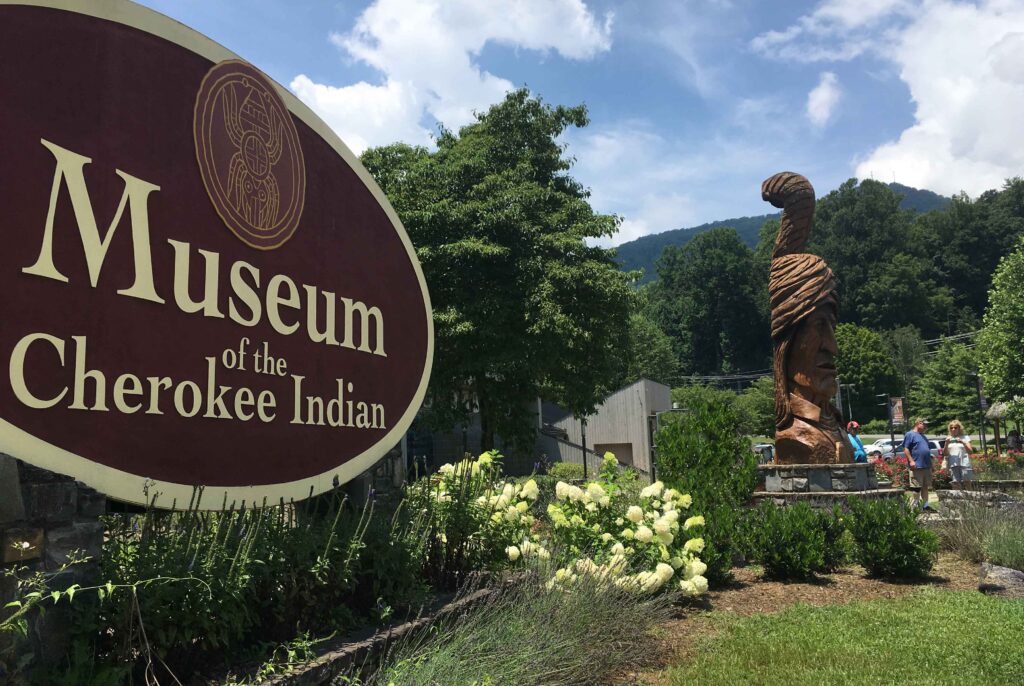
authentic educational sites such as the Museum of the Cherokee Indian and the Oconaluftee Indian
Village.
On the way into Cherokee, we drove through several small towns in Jackson County, including Sylva and
Dillsboro. Sylva, the County Seat has the quirky college town vibe influenced by nearby Western
Carolina University. You’ll find craft brewing, funky little shops and used bookshops. Sylva’s tiny
neighbor, Dillsboro, is a village of arts and crafts stores. Some places are the type of store where you’d
buy your granny a gift, but the Tree House Pottery was a cool shop featuring several potters. We chatted
with the owner about bear safety while he threw clay on his wheel.
Another stop was Juduculla Rock, huge boulder carved in ancient Cherokee hieroglyphics. It’s a bit out of
the way from the main highway, but only by a few minutes. If it’s a must-see for anyone who is interested
in archaeology or ancient ruins. A boardwalk around the rock protects the carvings. Visitors shouldn’t
touch the rock.
Upon entering Cherokee, we saw Oconaluftee Islands Park where people enjoyed splashing and wading
in the water on a warm day. The Visitor Center also overlooked the river, and many people lingered in
rocking chairs off the back porch overlooking the river. They told us about several special events,
including a free Saturday night bonfire weekly during the summer, and it’s definitely worth stopping by
to find out what daily events might be happening.
Our first educational experience was outside the Museum of the Cherokee Indian. Although there is an
admission charge for entry, that day the museum was holding free demonstrations for visitors. We saw
three men in traditional clothing cooking buffalo meat on a rack that, at first, I thought was bamboo, but I
later discovered it was river cane. We learned more about river cane when we participated in a weaving
activity. A Cherokee museum employee showed children how to weave paper strips into traditional
patterns. Another man did beadwork, while a different man showed us how to man a fire with a stick and
a rock. He actually used the grease of my child’s nose to help start his fire! He had her rub her nose into a
divet in his rock. Then, he created smoke with a piece of tree bark that he’d worked with his hands into
fibers like a cotton ball.
Oconaluftee Indian Village attracted our attention. The attraction transports visitors to the 1700s, and a
guide explains the Cherokee way of life. Unfortunately, we had limited time, and the admission fees for
these attractions add up quickly. We’ll have to go another time.
Instead we found some street performers who danced for a crowd. Their garb was more showy than
traditional, so it’s hard to know how authentic some of the dancing was. There was, however, a hoop
dancing champion, a 20 th century Native American dance, and its origins are not Cherokee. In fact, you’ll
see several individuals dressed up in the costumes you’d see in cowboy movies, but these guys are just
out to appeal to tourists. The traditional Cherokee clothing has more earth-tones than flashy colors.
We practically had to drag our kids out of Twisted Sisters, a boutique you can’t possibly miss with the
brightly colored metal yard art on the porch. All kinds of jewelry and quirky wares fascinated them. They
didn’t want to leave.
Being so close to the National Park, there are two waterfalls on Indian land. One is Soco Falls, which we
weren’t able to visit this trip. The other is Mingo Falls, which was an incredible experience.
When we first arrived, I was nervous. A set of stairs disappeared into the trees, as high as I could see. The
stairs were tough, but thankfully, there weren’t more beyond what I first saw from the parking lot! Then,
the rest of the trail leveled out, and it wasn’t far. We ended at a bridge overlooking one of the most
amazingly high waterfalls I’ve ever seen. It was so incredibly tall, I couldn’t get the whole falls into a
vertical shot from the bridge.